



Monthly Dispatch
Vol. I · No. 01
July 2026
The Westerra Dispatch
Food, beverage & agribusiness intelligence that moves deals forward
Were you forwarded this email? Subscribe here
Upstream
Ag Inputs · Equipment · Animal Health
YTD Stock Price Performance
Midstream
Processing · Ingredients · Mfg
YTD Stock Price Performance
Downstream
Distribution · Pkg Food & Bev
YTD Stock Price Performance
Source: Westerra Capital proprietary composite index · as of June 25, 2026
i. the spotlight
One story from each part of the chain: plus this month’s deep dive
Beyond Human Nutrition: The Three Pillars of the Nutrition Economy
Humans need vitamins, minerals, and supplements to thrive. So do animals. So do plants. There are entire industries built around each of those end markets, and right now, two of the three are significantly underappreciated by investors.
The human nutrition category, vitamins, minerals, supplements, functional foods, and the emerging GLP-1-adjacent segment, remains a real and growing market. Early-mover platforms that scaled ahead of consumer demand were rewarded handsomely. But the category is increasingly competitive: private label pressure is intensifying, multiples in the VMS segment have compressed, and the next dollar in requires a sharper edge than the last. The question for investors today is not whether human nutrition works. It is whether the best risk-adjusted returns are still found there, or whether capital should be looking at the ecosystems serving the other two pillars.
Animal Nutrition: Two Markets Inside One Sector
Animal nutrition is not one category. It is two fundamentally different investment profiles operating under the same umbrella. The first is livestock and production animal nutrition. Feed additives, including amino acids, enzymes, probiotics, mycotoxin binders, and specialty minerals, are non-discretionary inputs tied directly to global protein demand. As global protein consumption rises, the economics of feed efficiency and yield become structurally attractive. The middle market is highly fragmented, and specialty feed additive companies represent active deal targets for strategic acquirers.
The second is companion animal and pet health, a faster-growing, higher-multiple category driven by the pet humanization trend. This is not a protein consumption story. It is a veterinary care story: advanced diagnostics, therapeutics, and e-commerce channels driving premium spend on animal health rather than animal feed. The veterinary API manufacturing market is expanding materially through 2035. However, we are in the final innings of humanization. Companion pet populations are stagnant or declining and the market is largely consolidated. There will be pockets of opportunity in the segment, but the next wave of returns will be derived upstream.
Plant Nutrition: Commodity Inputs and the Value-Added Upgrade
Plant nutrition follows the same structural logic. At the commodity end, potash, nitrogen, and phosphate fertilizers are cyclical, macro-driven, and priced accordingly. They are important but not where the interesting investment activity is concentrated.
The value-added tier is a different story. Specialty crop nutrition products, including biostimulants, micronutrient blends, and biological soil amendments, are growing at multiples of the commodity market. Biologicals more broadly, spanning biostimulants, biocontrol agents, and biological inputs that improve crop health and yield, are compounding at low-to-mid-teens rates. Large-cap strategics including Corteva, Syngenta, and BASF are all running active M&A programs in this space. The “clean input” movement is real: growers are increasingly pulling for solutions that deliver yield improvements with a smaller synthetic footprint, and the middle market serving those growers is highly fragmented.
What connects all three pillars is the underlying logic: organisms, whether human, animal, or plant, need inputs to perform. The industries serving those needs share structural characteristics: fragmented middle markets, non-discretionary demand, ingredient-level pricing power, and recurring customer relationships. Human nutrition built those characteristics into recognizable investment platforms over the past decade. Animal and plant nutrition are earlier in that process.
Takeaway
The takeaway for owners and acquirers is straightforward. Across inputs and ingredients, capital is concentrating around two attributes, defensibility and market opportunity, and it will arrive through either development or consolidation to secure them. Expect more strategics to free trapped ingredient assets into the hands of sponsors, and more sponsors and strategics to compete for the pure-play platforms that already have both. The brand layer will keep making the headlines, but the layer below is where this cycle is quietly being underwritten.
— market sizing: the three pillars of nutrition —
Human Nutrition
Protein, functional foods, supplements, GLP-1-adjacent nutrition
Animal Nutrition
Bifurcated: livestock feed efficiency + companion animal pet health
Plant Nutrition
Commodity (potash, NPK) + high-growth biologicals
Sources: Human Nutrition: SNS Insider / GlobeNewswire (2025). Animal Nutrition: IMARC, Global Animal Feed Market Report (2025). Plant Nutrition: IMARC / GlobeNewswire (2025).
— tldr —
i.
The nutrition economy has three pillars: human nutrition (real, competitive, and maturing), animal nutrition (fragmented, bifurcated between livestock and companion animal), and plant nutrition (split between commodity inputs and a fast-growing value-added tier including biologicals).
ii.
The value-added plant nutrition tier, including biologicals and specialty crop inputs, is growing at low-to-mid-teens rates with active M&A from Corteva, Syngenta, and BASF. The companion animal market is largely consolidated; the more compelling setup is in livestock and plant nutrition where fragmentation is highest.
iii.
Both animal and plant nutrition offer fragmented middle-market dynamics that reward active dealmakers. Capital is concentrating around defensibility and market opportunity, arriving through development or consolidation at innovative, independent operators lagging consumer trends.
i. the landscape
Where the money is moving across food, beverage & agriculture
The Rate Hike Threat Is Back. Here’s What It Means for FBA Deals.
PCE just hit a three-year high. Rate cuts are off the table. And in a market where buyers are already paying up for quality, the cost of capital just got a lot more relevant.
The Fed’s preferred inflation measure hit its highest reading in three years at the end of June, and with it, whatever remained of the rate-cut narrative evaporated. The market isn’t just pushing out expectations anymore; it’s starting to price in a hike. For FBA deal professionals, the read-through is straightforward: LBO capacity tightens, middle-market structures get harder to finance, and strategic acquirers with clean balance sheets widen their edge over sponsors.
What this environment does, more than anything, is sharpen the penalty for buying the wrong asset. Businesses with recurring revenue, non-discretionary demand, or real pricing power are holding multiples. Commodity-exposed names and legacy ultra-processed platforms are not, and the gap is widening. Sponsors can always paper over modest growth with capital structure in a low-rate world. That math stops working when rates stay elevated.
Kraft Heinz made this concrete in early July. The company reorganized into three global regions, collapsed procurement and supply chain under one executive, and began cutting senior headcount. Management called it a push for “volume-led growth.” The more honest read is a portfolio of legacy brands getting squeezed from two directions at once: the MAHA consumer shift pulling volume away from ultra-processed products, and a cost of capital that no longer forgives slow-growth assets.
Danone is playing a different hand. The company closed Huel in March and MADE Group in June, two back-to-back moves into high-growth, better-for-you platforms. That is not opportunism. Danone has picked a side in a bifurcated market and is writing checks to prove it. In this rate environment, that kind of conviction is the only thing that justifies the premium.
— the pulse —
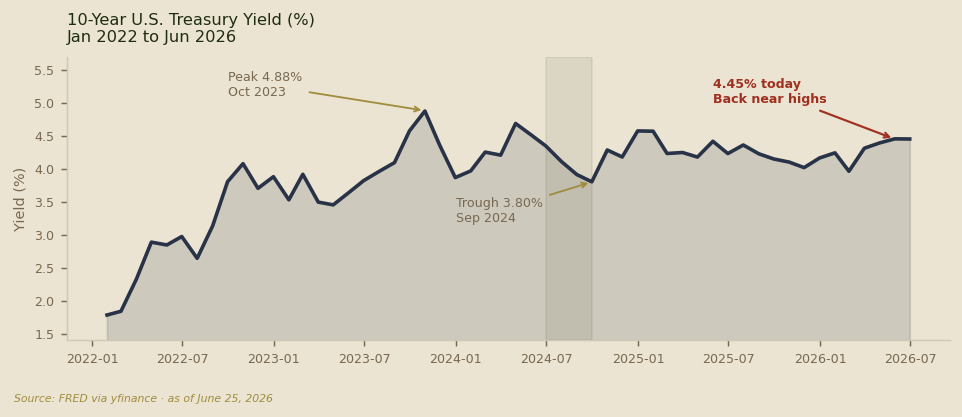
RATES
10-Year Treasury Yield Back Near Cycle Highs
The 10-year closed June 25 at 4.45%, well off its September 2024 trough of 3.80% and closing in on the October 2023 cycle peak of 4.88%. Long rates never really came down the way the Fed’s 2024-2025 cuts implied they would, and now they’re moving higher again. For deal math, that means wider discount rates and tighter LBO structures.
Source: FRED as of June 25, 2026
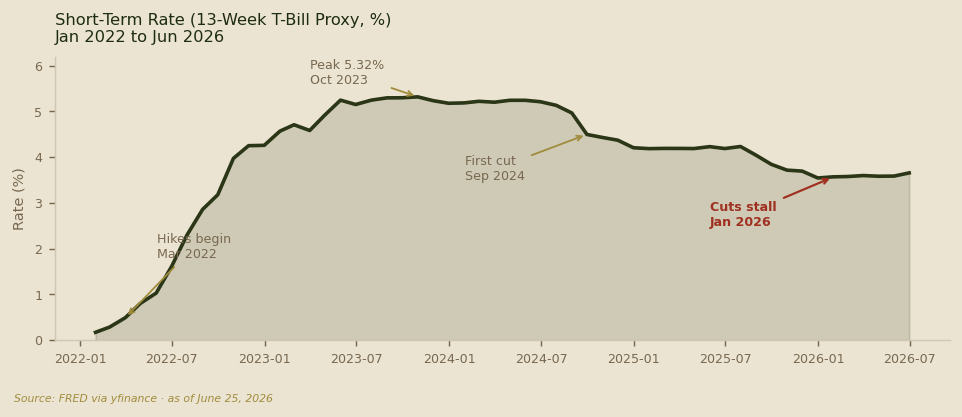
SHORT-TERM RATES
Fed Funds Cuts Have Stalled at 3.59%
The Fed cut 100 basis points in the back half of 2024, then stopped. The 13-week T-bill sat at 3.66% on June 25, barely off a 2025 low of 3.55%. With PCE at a three-year high, the market has given up on 2026 cuts entirely and is starting to price in a move higher. Sponsors running LBO models off stale rate assumptions are going to feel that.
Source: FRED as of June 25, 2026
IPO MARKET
Suja Life (NASDAQ: SUJA) Opens a Window
Suja Organic priced on Nasdaq May 7 under SUJA, the first FBA IPO of the year. Q1 net sales came in at $107.1 million, up 22.5% year-over-year, with EBITDA moving in the right direction. The real question is whether public market investors will pay a growth multiple for a better-for-you beverage platform in a rate environment like this one.
STRATEGIC CAPITAL
Ingredion Signals M&A Commitment with Board Refresh
Ingredion added Kenneth Escoe to its board in June, a hire flagged as M&A-experienced. The timing is not subtle: the company had just launched a firm all-cash offer for Tate & Lyle at 595p per share, valuing the business at roughly £3.7 billion. Ingredion also declared its $0.82 quarterly dividend payable July 21.
♦ marquee deal
Tessenderlo Group Takes $400M Stake in FMC Corporation
A Belgium-based agribusiness makes a major bet on U.S. crop protection at an inflection point for the sector.
Tessenderlo Group, the Belgium-based agribusiness and specialty chemicals conglomerate, has agreed to a $400 million minority equity investment in FMC Corporation, one of the largest U.S. crop protection companies. The deal arrives as FMC has been openly exploring strategic options, with CEO Pierre Brondeau signaling a potential sale of the crop protection business as recently as June 2026. Tessenderlo’s move injects capital and signals strategic conviction in FMC’s platform ahead of any broader process. For the sector, it underscores two themes playing out simultaneously. First, international appetite for U.S. ag inputs exposure, and second, the accelerating pace of consolidation in crop protection as the biologicals upgrade cycle pulls capital toward scale platforms with established distribution. Whether the Tessenderlo stake is a prelude to a full acquisition or a strategic foothold remains to be seen, but the $400 million commitment is not a passive position.
Deal Metrics
Investor
Tessenderlo Group
Target
FMC Corporation
Investment
$400M
Structure
Minority Equity
Sector
Crop Protection / Upstream Ag
Announced
July 2026
iii. the deal board
|
Target
|
Acquirer
|
Value
|
Closed
|
|---|---|---|---|
Target
Acquirer
Value Closed
MADE Group
Healthy nutrition platform, Asia-Pacific. Acquired by Danone.
Super-Sod (Patten Seed)
Leading turfgrass sod & seed producer, Southeast U.S. Acquired by Kainos Capital.
AeroFarms
U.S. microgreens leader. Acquired by an affiliate of Palm Ventures to expand distribution.
Jimmy’s Gourmet Bakery
Specialty bakery producer. Acquired by Rise Baking Company.
Twang Foodservice
Beverage flavor innovation platform. Acquired by Solina to expand into beverage.
Epicurean Butter
Denver-based compound butter and flavored dairy solutions maker. Acquired by Solina to expand dairy and culinary innovation capabilities.
Highland Baking
U.S. bakery producer. Acquired by Europastry to expand U.S. footprint.
Tillamook Country Smoker
Meat snack & jerky producer. Acquired by Second Nature Brands.
Prebiotic Fiber Brand
Prebiotic fiber ingredient brand joins the Ingredion portfolio.
iv. on the horizon
“Private equity is tightening its grip on food and beverage, driving change through strategic investments, acquisitions and operational overhauls. Firms are targeting everything from emerging challenger brands to established legacy companies, attracted by steady consumer demand, strong cash flow potential and opportunities for value creation.”
FoodNavigator, June 26, 2026
|
on the horizon
|
|
|---|---|
v. what we’re reading
Upstream: Inputs & Primary Production
MAHA-driven ingredient reformulation and the biologicals upgrade cycle are reshaping the upstream investment thesis.
MAHA / Ingredients
Beef Tallow Takeover? Big Food Companies Begin to Embrace MAHA Ingredient
Sales of food products with beef tallow as an ingredient surged to $1.1 billion for the 52 weeks ended March 22, up 275% from three years prior, per Spins. Major brands including Utz and Conagra are incorporating beef tallow following FDA’s January 2026 dietary guideline update. Food Dive, June 2026.
Crop Protection / M&A
FMC Corporation Reaches Agreement for $400 Million Minority Equity Investment from Tessenderlo Group
FMC Corporation has agreed to a $400 million minority equity investment from Tessenderlo Group, a Belgium-based agribusiness. The deal injects capital into FMC ahead of a potential strategic transaction and signals renewed institutional conviction in the crop protection sector. Tessenderlo’s move also underscores international appetite for U.S. ag inputs platforms as the biologicals upgrade cycle accelerates. FMC Corporation, July 2026.
AgTech / Financing
Avalo Raising $30M for AI-Guided Crop Breeding
Avalo is raising a $30 million round to scale its AI-guided crop breeding platform. Interest signals continued sponsor conviction in the AI-plus-ag intersection, with a specific focus on accelerating trait discovery and reducing conventional breeding cycle times. June 2026.
Food Inflation
May 2026 CPI and PPI Reports: The Food Price Pipeline Is Loading at Record Rates
Purdue’s Center for Commercial Agriculture flags that May 2026 CPI and PPI data show the food price pipeline loading at record rates. Producer prices are increasing faster than consumer prices, signaling margin pressure ahead for downstream food processors and CPG brands. Purdue University Center for Commercial Agriculture, June 2026.
Midstream: Processing, Ingredients, Packaging, Logistics
Big Food restructuring and escalating protein competition are the dominant midstream stories.
M&A
Kraft Heinz Overhauls Operating Structure to Accelerate Growth
Kraft Heinz reorganized into three global regions (North America, Europe and Pacific Developed Markets, and Emerging Markets) effective July 1, 2026, cutting senior leadership and consolidating procurement and supply chain. CEO Steve Cahillane cited “volume-led growth” as the objective. Food Dive, June 18, 2026.
M&A
Chobani Sued by Danone over High-Protein Yogurt Claims
Danone sued Chobani in the Southern District of New York alleging manipulation of serving sizes on 32-ounce containers to inflate protein content claims. The lawsuit argues Chobani’s 6.7-ounce serving (vs. FDA’s 5.3-ounce standard for multi-serve containers) enables a false 20g protein claim. 70% of shoppers aimed to increase protein intake in 2025, per IFIC. Food Dive, June 2026.
Packaging
Anheuser-Busch Invests $20M in Michelob Ultra Production in Bet on Beer Rebound
AB InBev’s Anheuser-Busch will invest $20 million in its St. Louis flagship brewery and a Missouri can plant to scale Michelob Ultra production, the number one beer by volume in the U.S. Part of a broader $600 million U.S. manufacturing commitment announced earlier this year. Food Dive, June 17, 2026.
M&A (Context)
Sazerac Launches 3 Canned Cocktail Brands to Reach Young Drinkers
Sazerac launched three new RTD canned cocktail brands targeting younger drinkers. The U.S. spirit-based RTD cocktail market grew 23% in the past year per Nielsen, cited by Sazerac. The lineup spans whiskey lemonade and vodka-based cream soda formats. Food Dive, June 25, 2026.
Downstream: Consumer Brands, Retail, Foodservice
SNAP policy uncertainty, escalating protein competition, and the RTD spirits surge are defining the downstream landscape.
RATES
Judge Blocks States from Excluding Soda and Candy from SNAP
A federal judge ruled the USDA exceeded its legal authority in approving SNAP waivers restricting candy and soda in five states. Numerator estimated a potential $830 million sales loss in targeted categories if the waivers had taken effect. Food Dive, June 24, 2026.
M&A
Sazerac Launches 3 Canned Cocktail Brands to Reach Young Drinkers
Sazerac launched three new RTD canned cocktail brands targeting younger drinkers. The U.S. spirit-based RTD cocktail market grew 23% in the past year per Nielsen, cited by Sazerac. Heineken separately named a new CEO, tasked with turning around a business that cut up to 6,000 roles amid declining beer sales. Food Dive, June 25, 2026.
PE / Consolidation
Private Equity Reshapes Food and Beverage Through Deals and Consolidation
Private equity is tightening its grip on food and beverage, driving change through strategic investments, acquisitions, and operational overhauls. Strategic buyers still dominate roughly 88% of transaction activity, but sponsor influence is expanding, and higher rates and inflation are tightening valuations and slowing deals. FoodNavigator, June 26, 2026.
westerracapital.com