



Monthly Dispatch
Vol. I · No. 01
June 2026
The Westerra Dispatch
Food, beverage & agribusiness intelligence that moves deals forward
Upstream
Ag Inputs · Equipment · Animal Health
YTD Stock Price Performance
Midstream
Processing · Ingredients · Mfg
YTD Stock Price Performance
Downstream
Distribution · Pkg Food & Bev
YTD Stock Price Performance
Source: Westerra Capital proprietary composite index · as of June 8, 2026
i. the landscape
Where the money is moving across food, beverage & agriculture
Capital Is Back. Not for Everything.
The food, beverage, and agriculture capital market has reopened, but is not paying for everything equally. For owners, the question is no longer whether buyers are active. It is which assets they will compete for, and which they will let walk.
Three forces are driving the reset. Rates have fallen far enough that leverage math which wouldn’t close at the peak now pencils, bringing financial sponsors back alongside strategics. Big Food is shedding: Nestlé, Kraft Heinz, Unilever, Ferrero, and Mars have all moved to recut their portfolios, and the carve-outs flowing from that are not distressed assets; they are sound businesses that no longer fit. And Washington has entered the underwriting conversation in a way it hasn’t in decades: the MAHA agenda formally targets ultra-processed food as a driver of chronic disease, and that exposure now reads as a valuation discount, not a footnote.
The result is a market sorting into two lanes. Fresh, functional, protein-forward, and clean-label assets are drawing real competition. Legacy commodity and ultra-processed portfolios are under pressure to reformulate, divest, or accept a lower clearing price. The spread between them is widening. The premium goes to owners who move early, with a defensible thesis and clean financials, not to those who transact on someone else’s timeline.
The data below puts that in context. North American deal activity has held up through the rate cycle, with volume remaining relatively steady even as a handful of large transactions drove aggregate value. More telling is the valuation picture: EV/EBITDA multiples pulled back to 9.9x in 2023 as capital tightened, then recovered sharply to 11.3x in 2024 and 11.4x in 2025. In Q1 2026 they reached 12.1x, above the prior peak of 11.7x in 2022. Buyers are not just active; they are paying up. The market is not open equally for everything, but for the right assets, it is as competitive as it has been in years.
— the pulse —
M&A Activity
Big Food divesting; specialists consolidating
Large-cap food and ingredients companies are shedding non-core divisions at pace: generating a steady supply of well-positioned assets for PE and strategic buyers. The pattern is visible up and down the value chain, from produce to specialty ingredients. See Spotlight for deal specifics.
Health & Consumer Trends
MAHA reshapes the policy landscape
The White House MAHA initiative formally targets ultra-processed food as a driver of childhood chronic disease, committing to a “coordinated transformation” of the food system. Valuations for clean-label and functional assets are responding. Source: whitehouse.gov/maha.
Capital Markets
PE dry powder active in food & ag
Private equity is deploying into food and ag with discipline: carve-outs, specialty ingredient platforms, and fresh category consolidation are all seeing activity. Strategic fit and defensibility are the common threads. Two live examples in the Spotlight.
Policy & Macro
Tariffs & screwworm add upstream risk
Trade policy uncertainty and the ongoing New World screwworm outbreak are adding cost and supply chain risk at the upstream level: relevant to protein processors, livestock producers, and any FBA business with import-dependent inputs. Source: USDA APHIS (aphis.usda.gov).
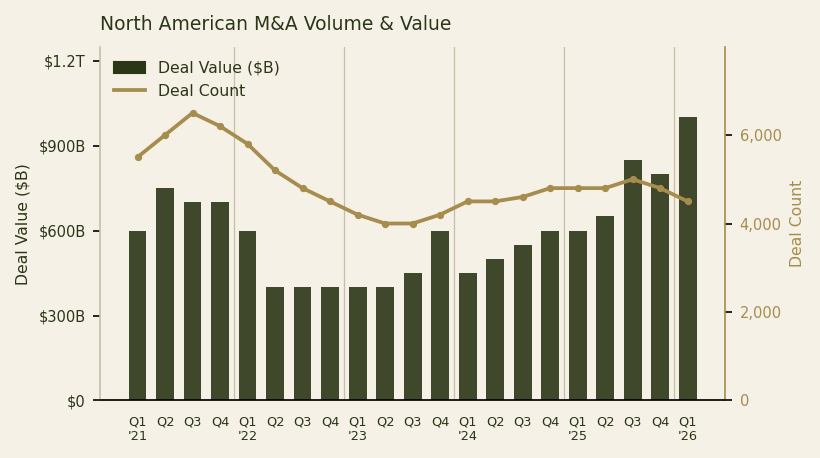
Fig. 1 · North American M&A Volume & Value, Q1 2021–Q1 2026
Source: PitchBook, Q1 2026
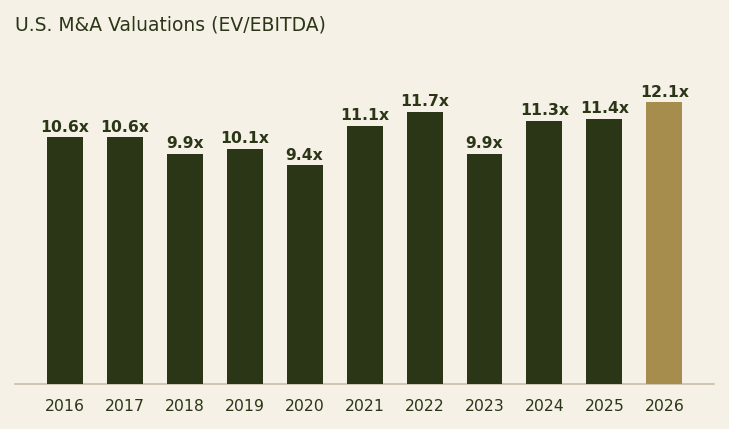
Fig. 2 · U.S. M&A Valuations (EV/EBITDA), 2016–2026
Source: PitchBook, Q1 2026
ii. the spotlight
One story from each part of the chain: plus this month’s deep dive
The Great Ingredients Breakup: Why $20B+ of Assets Are in Motion
In the food industry’s reformulation, the durable money sits one layer below the brand. Within a single fortnight, a private equity sponsor and a strategic acquirer paid up for that layer from opposite sides of the deal table. The mechanism differed. The logic did not.
The consumer story in food is loud and brand-level: less sugar, more protein, cleaner labels, shorter ingredient lists. The investable story is quieter and sits one layer down, with the companies that supply the texturants, sweetener systems, fibers, and emulsifiers that make reformulation possible. Two transactions in the space of about two weeks turned that layer into the most interesting real estate in the sector, and they did so from opposite sides of the table.
Start with the seller. In late May, IFF agreed to sell its Food Ingredients division to the private markets manager CVC Capital Partners for $4.3 billion, roughly ten times the unit’s EBITDA. This was not a distressed sale. The division, which spans texturants, emulsifiers, plant-based solutions, and cultures, generated about $3.1 billion of revenue in 2025, and IFF has guided to $10.5 to $10.8 billion in full-year 2026 revenue with the division still inside the group ahead of an expected close at the end of the second quarter of 2027. The issue was fit, not health. After a decade of conglomerate-building through large mergers, IFF concluded it could not fund the division’s capital needs while also investing behind its higher-margin scent, taste, and biosciences businesses. So it chose to refocus, retaining roughly a 10% stake and taking about $3.8 billion in net cash proceeds, much of it earmarked for debt reduction.
What CVC is buying is defensibility. Specialty ingredients are embedded deep in customers’ formulations and production lines. Once a texturant or emulsifier is designed into a product and cleared by quality and regulatory teams, replacing it is slow and expensive. That produces sticky relationships, reformulation know-how that compounds over time, and switching costs that suppress customer churn. For a sponsor underwriting cash-flow durability rather than top-line fireworks, a scaled, capital-starved but defensible ingredients platform is close to an ideal asset.
Now the buyer. On May 14, Ingredion confirmed it was weighing a possible all-cash offer for Tate & Lyle under Rule 2.6 of the UK Takeover Code, starting a clock that required it to commit or walk away by June 11. It committed. On June 8, Ingredion announced a firm, board-recommended all-cash acquisition at 595 pence per share, an approximate 59% premium to Tate & Lyle’s pre-approach closing price, valuing the equity at about £2.7 billion ($3.6 billion) and the enterprise at roughly £3.7 billion ($5.0 billion). The combination pairs Tate & Lyle’s strength in sweetening, mouthfeel, and fortification with Ingredion’s texturants and sugar-reduction systems, creating one of the largest specialty ingredients platforms in the world, with combined revenue near $10 billion. Completion is not immediate and remains subject to shareholder and regulatory approval, but this is an agreed transaction, not a rumor.
Read together, the two deals describe a single repricing. One company is shedding an ingredients business and the other is buying one, yet both buyers are paying for the same thing: control of the defensible, reformulation-critical chemistry that food and beverage manufacturers cannot easily switch away from. CVC is acquiring that defensibility as a standalone cash engine. Ingredion is acquiring it as scale, betting that a broader toolkit makes it a more indispensable single supplier to customers reformulating across sugar, texture, fiber, and protein at the same time.
The common driver is structural. Consumer demand for better-for-you products, the regulatory pressure crystallized by the Make America Healthy Again agenda, and the protein-and-satiety shift accelerated by GLP-1 adoption are all pushing brands toward continuous reformulation. The suppliers that enable that reformulation occupy something like a toll road. Whichever consumer brands ultimately win the clean-label contest, the ingredient platform underneath gets paid. That is why a sponsor will underwrite a carve-out at ten times EBITDA and a strategic will pay a 59% premium in the same month.
The takeaway for owners and acquirers is straightforward. In ingredients, capital is concentrating around two attributes, defensibility and scale, and it will arrive through either de-conglomeration or consolidation to secure them. Expect more strategics to free trapped ingredient assets into the hands of sponsors, and more sponsors and strategics to compete for the pure-play platforms that already have both. The brand layer will keep making the headlines. The layer below it is where this cycle is quietly being underwritten.
— deal metrics —
IFF → CVC Capital
Ingredion → Tate & Lyle
Sources: IFF 8-K (SEC EDGAR, June 1, 2026) · Ingredion 8-K EX-99.1 (SEC EDGAR, May 14, 2026) · Ingredion RNS (June 8, 2026)
— takeaways —
i.
Two directions at once: IFF is selling to PE, Ingredion is buying. Both reflect the same thesis. Scale and focus beat diversified conglomerates in specialty ingredients.
ii.
Neither deal is distress. Both buyers are paying up for defensibility, reformulation IP, and customer switching costs. That is the new underwriting thesis in food ingredients.
iii.
More of this is coming. Expect strategics to shed more trapped ingredient assets and sponsors and strategics to compete for pure-play platforms that already have scale and defensibility.
|
Target
|
Acquirer
|
Value
|
Closed
|
|---|---|---|---|
iii. the deal board
Target
Acquirer
Value Closed
Calavo Growers
Leading processor and distributor of fresh avocados, guacamole, and value-added produce.
Ocean Brands
Richmond, BC-based canned and frozen seafood producer; tuna, salmon, oysters, and shrimp.
Phoenix Flavors & Fragrances
New Jersey-based developer and manufacturer of fragrance and flavour extracts.
Kitchen Partners
Edmonton-based manufacturer of sauces, marinades, dips, and soups; third add-on under e2p ownership.
AgBioTech Assets *
Specialty agricultural biologicals and biotech portfolio; details pending public announcement.
Nugredient *
Specialty nutrition and functional ingredient platform; transaction details pending confirmation.
Greenfruit Avocado *
California-based vertically integrated avocado grower and packer.
Brothers International Food *
Long-established manufacturer of BBQ sauces, hot sauces, and specialty seasonings.
Miami Beef (Young American Food Brands)
Miami-based premium, organic, and Wagyu beef processing platform; acquired from Trivest Partners.
Van’s Foods
Branded frozen breakfast company (waffles, prepared breakfast items); carved out of Sara Lee Frozen Bakery.
Fromatech Ingredients
Netherlands-based manufacturer of savoury flavour systems, seasonings, and cheese-derived ingredients.
Vestaron Corporation
Developer of spider-venom-derived bioinsecticides for broad-spectrum, low-residue crop protection.
Tate & Lyle
UK-listed specialty ingredients platform; sweetening, mouthfeel, fortification, and fibre systems.
IFF Food Ingredients
Globally recognised supplier of texturants, emulsifiers, plant-based solutions, and cultures.
* Details pending public confirmation at time of publication.
iv. on the horizon
“Many acquisition targets”, Dirk told analysts, “have simply become ‘too expensive’ to justify: unless a brand brings a genuine competitive edge.”
— Dirk Van de Put, Chair & CEO, Mondelēz International
|
on the horizon
|
|
|---|---|
v. what we’re reading
Upstream: Inputs & Primary Production
The dominant story is a split farm economy: row crops squeezed, protein tight and elevated.
Markets
Grain and Livestock Futures Under Pressure: Weather, Fund Selling
Grain markets slid to new lows in early June on weather and fund long-liquidation. The May Farm Journal Ag Economists’ Monitor flagged rising debt costs and growing financial stress, with economists warning many operations may need significant restructuring to remain viable. Jul corn ~$4.18, soybeans ~$11.16; Aug live cattle ~$237. AgWeb / Brownfield Ag News, Jun 2026.
Animal Health
New World Screwworm Escalating: Second Confirmed Case, Wider Restricted Area
A second confirmed NWS case is set to widen the restricted zone, with cattle-movement disruption spreading across Texas and into interstate movements. The U.S.-Mexico border remains closed to imported cattle, a supply constraint expected to keep feeder prices elevated through 2026–27 against a multi-decade-low cattle inventory. The Ag Center / American Farm Bureau, Jun 8, 2026.
Inputs / Fertilizer
Mosaic Pulls Guidance, Cuts Spending as Fertilizer Costs Surge
Mosaic swung to a Q1 loss as prices for sulfur, ammonia, and urea continued to climb on Persian Gulf supply disruption. The company is curtailing production, cutting capital spending, and reassessing its full-year operating plan. A reminder that input cost volatility remains a live risk for ag-facing businesses. The Wall Street Journal, 2026.
Biologicals
The 2026 Rise of Biologicals: BASF, Corteva, ICL All Moving
Biologicals consolidation is now a sector theme: BASF acquired AgBiTech (its first meaningful bio acquisition since 2012), Corteva posted $519M in biological revenue in 2025 ahead of its planned split, and ICL went from near-zero to $250M in new biological product sales in a single year. Upstream Ag Insights, 2026.
Midstream: Processing, Ingredients, Packaging, Logistics
Ingredients M&A is the headline, alongside a structural reframing of packaging.
M&A
IFF Food Ingredients → CVC Capital Partners, ~$4.3B
The Food Ingredients carve-out covered in depth in the Spotlight above. IFF retaining ~10% equity; close expected Q2 2027. Primary source: IFF Form 8-K, SEC EDGAR, June 1, 2026.
M&A
Ingredion → Tate & Lyle, Firm All-Cash Offer at 595p (£3.7B EV)
Board-recommended all-cash acquisition announced June 8; 59% premium to pre-approach price; combined revenue near $10B. Detailed in the Spotlight. Primary sources: Ingredion press release and Form 8-K, SEC EDGAR, June 8, 2026.
Packaging
Food Packaging Films Shifting Toward High-Barrier, Recyclable Formats
Food packaging films are moving toward recyclable mono-materials, high-barrier shelf-life technologies, and lightweight flexible formats as brands adapt to sustainability mandates and cold-chain logistics. A useful framing for any deal with a packaging angle. Future Market Insights via PR Newswire, May 20, 2026.
M&A (Context)
McCormick + Unilever Foods: ~$20B Combined-Revenue Food Platform
Announced March 31, 2026, the merger combines McCormick’s flavor business with Unilever’s Foods unit to create a roughly $20B combined-revenue food and foodservice player. A major midstream/branded-foods event just outside the current window. Packaging Digest, Mar 2026.
Downstream: Consumer Brands, Retail, Foodservice
Sponsor-backed roll-ups of better-for-you brands and continued retail and foodservice consolidation.
Retail / C-Store
Cumberland Farms Closes Coen Markets Acquisition
Cumberland Farms absorbed Coen Markets, a Pennsylvania c-store chain known for its fresh foodservice program and loyalty offering. CSP Daily News, June 8, 2026
M&A
B&G Foods Acquires College Inn and Kitchen Basics from Del Monte for ~$110M
B&G completed the ~$110M cash acquisition of Del Monte’s broth and stock business at roughly 5.5x adjusted EBITDA, expecting it to be immediately accretive. A clean small-cap example of Big Food portfolio reshaping at work. SEC EDGAR 8-K, March 19, 2026.
a word from the westerra team
Issue No. 01: Why We Built the Dispatch
Welcome to the first issue. We built Westerra to advise food, beverage, and agribusiness owners through the sale of their life’s work: and we built the Dispatch to give that same audience a sharp monthly read on where the market is moving and what it means for their options. Each month, the analysis we’d share with a client over coffee: no filler. We’re glad you’re here.
The Westerra Team
westerracapital.com